 Poptropica Cheats and Secrets Cheats, Walkthroughs and Secrets for Poptropica

Poptropica Mythology Island arrives for everyone in less than a week. Paid members have been able to play it for a few weeks, and you can even get the full Mythology Walkthrough right here. One of the best things about this new island is that it has a lot of real characters and events from Greek Mythology in the island. To help celebrate the upcoming release of the island for all players, I thought I’d do a series of posts on some of the characters from Greek Mythology that you’ll meet.
Spoiler warning! I’ll try not to give any important parts of the story away with these posts but if you want all of Mythology Island to be a surprise the first time you play it, don’t read any further!
Athena
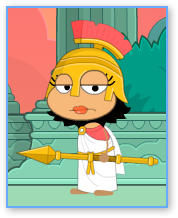
You’ll first encounter Athena in Poptropica at the Tree of Immortality and she’ll be a helpful guide as you go on the main quest to locate the five items that Zeus wants you to gather. She’ll also give you help when it comes time to convince Hercules to help you out on your quest. Finally, Athena shows up at the end of your epic battle with Zeus on top of Mount Olympus and will reward you with your island completion medal.
In Greek Mythology, Athena is the goddess of wisdom, war, the arts, industry, justice, and skill (Wow, that’s a lot of stuff for one goddess!) A neat thing about Athena is that when she was born, she sprung fully-formed from Zeus’ head (that must have hurt!) Her mother was Metis, who was Zeus’ first wife. Zeus was afraid that she would give birth to a son more powerful than he was, so he swallowed her up. That’s why Athena was born out of Zeus’ head. Kind of makes sense, I guess.
Athena’s main claim to fame is that she was very fond of a special and important city in Greece. She gave the gift of an olive tree to that city, and the people of the city were so happy with the food, wood and oil it provided that they named their city after her. Thus, Athens, the greatest city in all of ancient Greece, was born.








so cool!!!!!!!!!!!!!!!!!!!!!!!!!!!!!!!!!!!!!!!!!!!!!!!!!!!!!!!!!!!!!!!!!!!!!!!!!!!!!!!!!!!!!!!!!?!!!!!!!!!!!!!!!!!!!!!!!!!!!!!!!!!!!!!!!!!!!!!!!!!!!!!!!!!!!!!!!!
So yeah, Athena was born out of Zeus’s head. He was afraid that Metis, the Titan of wisdom, was about to give birth ot a son that would be more powerful that him. So he turned her into a fly and swallowed her. He later complained of a headache, so he had Hephestos crack his head open, and so out came Athena, all grown up. Since Metis was the Titan of wisdom, that is how Athena became the godess of wisdom, as well as Zeus becoming the god of wisdom, because he swallowed Metis. The Greeks believed that the stomach was where you did your thinking. Athena is also famous for making the olive tree at Athens. Athena and Poseidon were fighting over whose name would be used for the name of the capital of Greece. They decided whoever made the best gift would be chosen. Poseidon made a spring which flowed water. One problem: salt water! Totally useless. Athena made an olive tree, which made the town very rich through trade. Hence, Athens, Greece. She is also infamous for turning Poseidons girlfriend, Medusa, into a gorgon. She was mad at Poseidon for bringing her into her temple. Why can’t Athena and her Uncle just get along??
It’s spelled Haphaestus… And Athena is the goddess of battle not war.
Whoa Mythoman it must take long to type all that
And…um…Zeus is Athena’s Uncle or what? 😕
sunny zeus is athenas dad and poseidon is her uncle.
how do you get past surper villans do yous no idont thats for shore
Thanks Sneaky Wing I like Greek Mythology we’re watching a film about it at home right now
Athena is the goddess of wisdom. And Arse is the god of war.
Posiedon Zeus and Hades make the big three. Kronos the father of the big three was killed by zeus posiedon and hades. The big three chopped him into pieces and threw him into tartarus.
Athena and Poseidon wont get along because before they were fighting for a position, i think. I don’t remember the positon though. Any, the people of olympus chose athena for the position. And ever since Athena and Poseidon never got along. 🙂
they were fighting omg why !
were they.
my charater almost looks like her.
ok ok back to poptopica. i won i won i won i have the mythology medal i’m a god yeppy
Jennelle is right .athena is the goddess of battle
http://fearth.altervista.org/immagini/Athena_p111.jpg
click to my comment and you will see athena
hehehehehe!!!!!!!!!!
WHAT is that ATHENA??
The poptropica island 4 mythology iz so weird!!! i mean, 1st of all, like poseidon and hades would evr giv u their stuf!!! sooooooo weird. but yah anyway, does anybody know how 2 get the cool costumes from other gods?? like artemis and stuf??
(duh and yeah mix together)
dyeah!!!!!!!!!!!!!!
you think its Zeus
for know on my name is fearless joker
is someone going to help me or not?
how do you make your character grow giant like the gods after you have won the mythology island medal???????????????????????????????????????????????????????
use hades crown and if you want to see me as a god go on my account my pass is ceerful and my user is lightning4021
ok?
awkward
WHY DONT THEY GET ALONG IT DEVASTATING!!!!
(WIPES TEAR FROM FACE)
DEVASTATING!!!!!!
krc
well i hope skulldugry is as cool as mytholygy ;0
I don’t know how to get the whisker from whats his face, from the under world! I need Heeeeeeeeeeeeeeeeeeeeeelp!!!!!! Please!
no! lol
cool acc ethan
Actually I got a Mythology class at school. Zeus is the king of Gods and the ruler of the sky.Hera ,Zeus’s “real” immortal wife and the Queen of the Gods. She is also the goddess of marriage.Hera and Zeus had 4 children together ,
Hephaestus, the god of fire and crafts; Ares, the god of war; Ilithyia, the goddess of childbirth; and Hebe, the cupbearer of the gods. Zeus had affairs with other goddesses and mortals.
Semele, a mortal woman who gave birth to Zeus’s son Dionysus*, was another of Hera’s victims. Hera suggested to Semele that she ask her lover to appear in his full glory. Zeus, who had promised to grant Semele any wish, sadly did so and appeared with his thunderbolts, causing Semele to burn to death immediately. Athamas, the king of Thebes, and his wife Ino, who later became a sea goddess, raised Dionysus after his mother’s death. Hera punished them as well by making them go mad. Hestia the goddess of the hearth gave up
her throne on Olympus when Dionysus became a god with out an arguement.
She then moved to the hearth in the middle of all the thrones .
Dionysus ended up as the god of wine . Athena The Goddess of Warcraft, Wisdom and Craft was sprung directly from the head of Zeus. Her mother was the Titaness Metis whom Zeus had swallowed whole in pregnancy. Hermes The God of Merchants, Shepherds and Messengers was a son of Zeus and the Pleiad Maia.
Artemis The Goddess of Hunting and Protectress of Young Girls and Apollo God of music healing and prophecy were daughter and son of Zeus and the Titaness Leto. APHRODITE The Goddess of Love was, according to some, a daughter of Zeus and the Titaness Dione (most accounts, however, say she was born in the sea from a peice of Ouranos after Kronos cut him up).The others are Persephone by Demeter and Hermes by Maia.
I hope they dont flag that as spam 🙁
in may 2011, i have to be a mythology wax figure. i hope to be athena.
in may 2011, i have to be a mythology wax figure. i hope to be athena. 😀 i hope i will be athena
Mortals keep forgetting that I’m a blonde.
Ummmm guys,you know how Persephone is Zeus’ daughter,and well Hades is Zeus’ brother,well this is awkward but I made the connection that PERSEPHONE IS DATING HER UNCLE!!!!!!!!!!!!!!!!!!!!!!!!!!!!!!!!!!!!!!!!!!!!! omigosh weird right??? dol!(dying of laughter)
They are gods, and aren’t you talking about yourself?
Lol! Got me new yahoo!
Did you know? Zeus married her one of 3 sisters the Hera.
Artemis outfit: http://www.poptropica.com/avatarstudio/avatar.html?a=bWnRxVUFhVFdWa2RYTmhOVEEz
Poptropica Green Lanterns Island in my Holiday Wish!
Did u know Green Lantern? Its here:
http://greenlantern.wikia.com
I drew Green Lanterns, Sinestro, Star Sapphire, Boodikka in poptropica style on notebook paper
I will show u next time!!!!!!!!!!!!!!!!!!!!!!!!!!!!!!!!!!!!!!!!!!!!!!!!!!!!!!!!!!!!!!!!!!!!!!!!!!!!!!!!!!!!!!!!!!!!!!!!!!!!!!!!!!!!!!!!!!!!!!!!!!!!!!!!!!!!!!!!!!!!!!!!!!!!!!!!!!!!!!!!!!!!!!!!!!!!!!!!!!!!!!!!!!!!!!!!!!!!!!!!!!!!!!!!!!!!!!!!!!!!!!!!!!!!!!!!!!!!!!!!!!!!!!!!!!!!!!!!!!!!!!!!!!!!!!!!!!!!!!!!!!!!!!!!!!!!!!!!!!!!!!!!!!!!!!!!!!!!!!!!!!!!!!!!!!!!!!!!!!!!!!!!!!!!!!!!!!!!!!!!!!!!!!!!!!!!!!!!!!!!!!!!!!!!!!!!!!!!!!!!!!!!!!!!!!!!!!!!!!!!!!!!!!!!!!!!!!!!!!!!!!!!!!!!!!!!!!!!!!!!!!!!!!!!!!!!!!!!!!!!!!!!!!!!!!!!!!!!!!!!!!!!!!!!!!!!!!!!!!!!!!!!!!!!!!!!!!!!!!!!!!!!!!!!!!!!!!!!!!!!!!!!!!!!!!!!!!!!!!!!!!!!!!!!!!!!!!!!!!!!!!!!!!!!!!!!!!!!!!!!!!!!!!!!!!!!!!!!!!!!!!!!!!!!!!!!!!!!!!!!!!!!!!!!!!!!!!!!!!!!!!!!!!!!!!!!!!!!!!!!!!!!!!!!!!!!!!!!!!!!!!!!!!!!!!!!!!!!!!!!!!!!!!!!!!!!!!!!!!!!!!!!!!!!!!!!!!!!!!!!!!!!!!!!!!!!!!!!!!!!!!!!!!!!!!!!!!!!!!!!!!!!!!!!!!!!!!!!!!!!!!!!!!!!!!!!!!!!!!!!!!!!!!!!!!!!!!!!!!!!!!!!!!!!!!!!!!!!!!!!!!!!!!!!!!!!!!!!!!!!!!!!!!!!!!!!!!!!!!!!!!!!
The greek gods are so gross. What’s up with the swallowing people and crazy lovesick uncles kidnapping their nieces and girlfriends turning into gorgons and babies left to defend themselves against snakes? Ok, that last one wasn’t too gross.
But the gods are really wierd cuz they all marry their brothers and sisters and have kids with them and stuff. It’s disgusting!!!! 😛 P.S. try the artemis huntress outfit on my name!!!!!
Wow.I can’t believe that Zeus had too many wives and children.I think Hades is pretty gross.The mother of Athena is Metis and the mother of Hercules is Alcmene.
It’s spelled Eileithyia,Hyper boot.
Athena is not the goddess of war or battle…Athena is the goddess of wisdom. She protects creatures such as snakes, spiders and other bugs as well.
Zues didn’t just love women, he had a few afairs with men as well. Mytholigy is really weird cause it’s like their all related some how it seems like, and they go around and sleep with each other…actully back in the very beginning with Adam and Eve, God created them as the first two people then they made children, and their children had to make children with each other and thats how all that happended. But its all a story in the bible so who knows if its true or not?
Actully Athena isn’t goddess of battle or war, she is the goddess of wisdom… she is the daugter of Zues…her enemy would be poseidon. Athena is as sharp as one of Zues thunderbolt, which is why she is the goddess of wisdom. She is also a warrior goddess. Olives, snakes, and spiders are all sacred to Athena. As for her father, he was actully a jerk just like how he treated his brothers poorly but also Zues didn’t just love women, he had a few afairs with men as well. Mytholigy is really weird cause it’s like their all related some how it seems like, and they go around and sleep with each other…actully back in the very beginning with Adam and Eve, God created them as the first two people then they made children, and their children had to make children with each other and thats how all that happended. But its all a story in the bible so who knows if its true or not?
Indeed,
Zeus was scared that Metis would give birth to a son that could be stronger than Zeus himself.
So, he turned Metis into a fly and ate her. Some time later, Zeus was complaining about a headache,
so asked Haphaestus to crack open his skull. And thats when Athena appeared as a grown woman in full battle gear. Athena became the goddess of Wisdom, Battle, Useful Arts. Poseidon and Hades ( As both brothers of Zeus) were Athena uncles. This is on of very known stories told about Athena and Poseidon: There was a city that everyone seemed to enjoy. But they had to chooses a patron for that city. (A god or goddess) Both Athena and Poseidon wanted to be that patron. So what they had to do was make a gift for the city. The creater of the best one would become the patron. Poseidon with his Trident made a Salt spring. It was a very beautiful gift. Athena made a olive tree that had 3 things very important for the city : Food, Wood and olive oil. It is why Athena’s olive tree was chosen to be a better gift. So the city was named after Athena and was called Athens !!!
(I’m kind of a myth kid I love everything bout mythology)
What really helped me was the Percy Jackson series 😉 give it a try !
Zeus,in Greek Mythology,the god of the sky and ruler of the Olympian gods.Zeus corresponds to the Roman god Jupiter.
Zeus was considered,according to Homer,the father of the gods and of mortals.He did not create either gods or mortals;he was their father in the sense of being the protector and ruler both the Olympian family and of the human race.He was lord of the sky,the rain god, and the cloud gatherer,who wielded the terrible thunder bolt.
Tell you more tomorrow.
Athena helped a lot and how do u click the olive on top of the gym it was so hard >:(
Zeus, in Greek mythology, the god of the sky and ruler of the Olympian gods. Zeus corresponds to the Roman god Jupiter.
Zeus was considered, according to Homer, the father of the gods and of mortals. He did not create either gods or mortals; he was their father in the sense of being the protector and ruler both of the Olympian family and of the human race. He was lord of the sky, the rain god, and the cloud gatherer, who wielded the terrible thunderbolt. His breastplate was the aegis, his bird the eagle, his tree the oak. Zeus presided over the gods on Mount Olympus in Thessaly (Thessalia). His principal shrines were at Dodona, in Epirus, the land of the oak trees and the most ancient shrine, famous for its oracle, and at Olympia, where the Olympic Games were celebrated in his honor every fourth year. The Nemean games, held at Nemea, northwest of Árgos, were also dedicated to Zeus.
Zeus was the youngest son of the Titans Cronus and Rhea and the brother of the deities Poseidon, Hades, Hestia, Demeter, and Hera. According to one of the ancient myths of the birth of Zeus, Cronus, fearing that he might be dethroned by one of his children, swallowed them as they were born. Upon the birth of Zeus, Rhea wrapped a stone in swaddling clothes for Cronus to swallow and concealed the infant god in Crete (Kríti), where he was fed on the milk of the goat Amalthaea and reared by nymphs. When Zeus grew to maturity, he forced Cronus to disgorge the other children, who were eager to take vengeance on their father. In the war that followed, the Titans fought on the side of Cronus, but Zeus and the other gods were successful, and the Titans were consigned to the abyss of Tartarus. Zeus henceforth ruled over the sky, and his brothers Poseidon and Hades were given power over the sea and the underworld, respectively. The earth was to be ruled in common by all three.
Beginning with the writings of the Greek poet Homer, Zeus is pictured in two very different ways. He is represented as the god of justice and mercy, the protector of the weak, and the punisher of the wicked. As husband to his sister Hera, he is the father of Ares, the god of war; Hebe, the goddess of youth; Hephaestus, the god of fire; and Eileithyia, the goddess of childbirth. At the same time, Zeus is described as falling in love with one woman after another and resorting to all kinds of tricks to hide his infidelity from his wife. Stories of his escapades were numerous in ancient mythology, and many of his offspring were a result of his love affairs with both goddesses and mortal women. It is believed that, with the development of a sense of ethics in Greek life, the idea of a lecherous, sometimes ridiculous father god became distasteful, so later legends tended to present Zeus in a more exalted light. His many affairs with mortals are sometimes explained as the wish of the early Greeks to trace their lineage to the father of the gods.
Zeus’s image was represented in sculptural works as a kingly, bearded figure. The most celebrated of all statues of Zeus was Phidias’s gold and ivory colossus at Olympia.
Poseidon, in Greek mythology, god of the sea, the son of the Titans Cronus and Rhea, and the brother of Zeus and Hades. Poseidon was the husband of Amphitrite, one of the Nereids, by whom he had a son, Triton. Poseidon had numerous other love affairs, however, especially with nymphs of springs and fountains, and was the father of several children famed for their wildness and cruelty, among them the giant Orion and the Cyclops Polyphemus. Poseidon and the Gorgon Medusa were the parents of Pegasus, the famous winged horse.
Poseidon plays a prominent part in numerous ancient myths and legends. He contended unsuccessfully with Athena, goddess of wisdom, for the control of Athens. When he and Apollo, god of the sun, were cheated of their promised wages after having helped Laomedon, king of Troy, build the walls of that city, Poseidon’s revenge against Troy knew no bounds. He sent a terrible sea monster to ravage the land, and during the Trojan War he helped the Greeks.
In art, Poseidon is represented as a bearded and majestic figure, holding a trident and often accompanied by a dolphin. Every two years the Isthmian Games, featuring horse and chariot racers, were held in his honor at Corinth. The Romans identified Poseidon with their god of the sea, Neptune.
Hades, in Greek mythology, god of the dead. He was the son of the Titans Cronus and Rhea and the brother of Zeus and Poseidon. When the three brothers divided up the universe after they had deposed their father, Cronus, Hades was awarded the underworld. There, with his queen, Persephone, whom he had abducted from the world above, he ruled the kingdom of the dead. Although he was a grim and pitiless god, unappeased by either prayer or sacrifice, he was not evil. In fact, he was known also as Pluto, lord of riches, because both crops and precious metals were believed to come from his kingdom below ground.
The underworld itself was often called Hades. It was divided into two regions: Erebus, where the dead pass as soon as they die, and Tartarus, the deeper region, where the Titans had been imprisoned. It was a dim and unhappy place, inhabited by vague forms and shadows and guarded by Cerberus, the three-headed, dragon-tailed dog. Sinister rivers separated the underworld from the world above, and the aged boatman Charon ferried the souls of the dead across these waters. Somewhere in the darkness of the underworld Hades’ palace was located. It was represented as a many-gated, dark and gloomy place, thronged with guests, and set in the midst of shadowy fields and an apparition-haunted landscape. In later legends the underworld is described as the place where the good are rewarded and the wicked punished.
Athena, one of the most important goddesses in Greek mythology. In Roman mythology she became identified with the goddess Minerva. Also known as Pallas Athena. Athena sprang full-grown and armored from the forehead of the god Zeus and was his favorite child. He entrusted her with his shield, adorned with the hideous head of Medusa the Gorgon, his buckler, and his principal weapon, the thunderbolt. A virgin goddess, she was called Parthenos (“the maiden”). Her major temple, the Parthenon, was in Athens, which, according to legend, became hers as a result of her gift of the olive tree to the Athenian people.
Athena was primarily the goddess of the Greek cities, of industry and the arts, and, in later mythology, of wisdom; she was also goddess of war. Athena was the strongest supporter, among the gods, of the Greek side in the Trojan War. After the fall of Troy, however, the Greeks failed to respect the sanctity of an altar to Athena at which the Trojan prophet Cassandra sought shelter. As punishment, storms sent by the god of the sea, Poseidon, at Athena’s request destroyed most of the Greek ships returning from Troy.
Athena was also a patron of the agricultural arts and of the crafts of women, especially spinning and weaving. Among her gifts to man were the inventions of the plow and the flute and the arts of taming animals, building ships, and making shoes. She was often associated with birds, especially the owl.
I copied this on my other post on the other website so it’s so fast.
Good I’m not the only one who likes Greek myths.
i love poptropica and its the only game i play on the computer….!
i love greek mythology. its so cool how they found an answer to some things we cant explain.
poptropica is awesome!!!! read percy jackson it has those myths too!! i love greece so much and artemis!!!!!
Guys,Athena is the goddess of wisdom,crafts and battle. Her half brother ares is god of war! She protects snakes,spiders,and owls. She is one of the virgin( yeah I said virgin. Go ahead and laugh but it’s true) goddess’s out of the three. The other two are Hestia and Artemis.
Artemis didn’t want to marry and she wanted to remain the wild young girl. She also liked Orin but her twin brother set out a scorpion to kill him. She helped with a plot to kill giant twin brothers. She “accepted” the offer to marry one of them and then turned into a deer. The boys were eager huntsmen and fell to death by each others javelins.
BTW I am a christian LOL (I have a book about this so…. yeah.)
She is a virgin